

This guide explains what business consulting services are, the different types of consulting available in Australia, the benefits for organisations and how to choose the right consulting partner.
What Are Business Consulting Services?
Business consulting services provide organisations with professional advice, strategic guidance and practical support to solve business challenges and improve performance.
A consultant works with business leaders and internal teams to understand existing processes, identify problems and opportunities, develop recommendations and create an implementation roadmap.
Depending on the organisation’s requirements, consulting may focus on:
- Business strategy and planning
- Digital transformation
- Technology strategy
- Enterprise architecture
- Operational improvement
- Project management
- Connectivity and network solutions
- Mobility and device management
- Internet of Things (IoT)
- Fleet technology
- Managed services
- Cost and resource optimisation
- Process improvement
- Risk and technology planning
The objective is not simply to recommend new technology. Effective consulting connects business requirements, people, processes and technology so that investments deliver practical outcomes.
Why Australian Businesses Use Consulting Services
Organisations often have internal teams with strong operational or technical expertise, but external consultants can provide additional experience, specialist knowledge and an independent perspective.
A business may engage a consultant when it is:
- Planning a major technology project
- Expanding into new locations
- Replacing outdated systems
- Managing complex technology environments
- Improving operational efficiency
- Introducing automation or IoT
- Deploying devices across a large workforce
- Reviewing connectivity requirements
- Managing a digital transformation programme
- Controlling technology costs
- Integrating multiple platforms
- Planning a new business initiative
- Requiring additional project management expertise
For small and growing businesses, consulting can provide access to specialised expertise without requiring a permanent internal team. For enterprise and government organisations, consultants can support complex programmes that require cross-functional coordination and strategic oversight.
The Australian Government also provides advisory resources for businesses covering areas such as business planning, online and digital services, AI, taxation, compliance and other business topics.
Types of Business Consulting Services in Australia
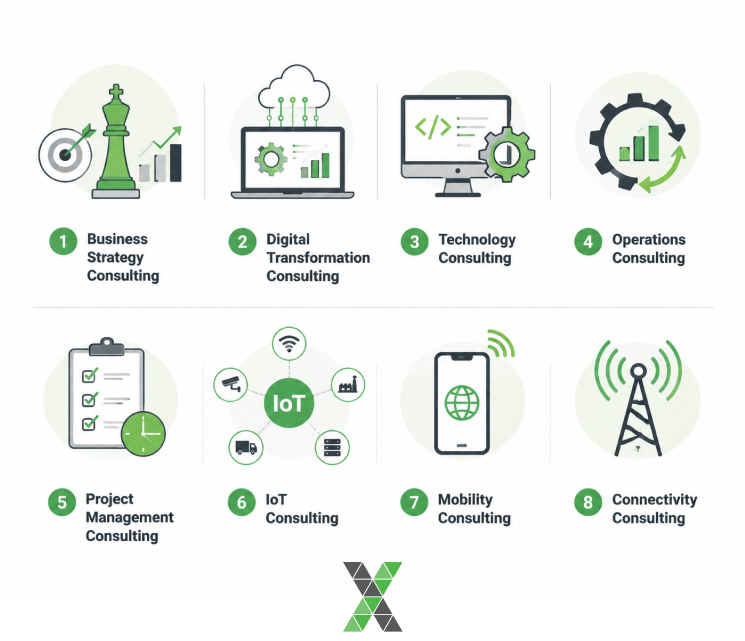 Business consulting covers a broad range of disciplines. The right service depends on the organisation’s objectives, existing capabilities and challenges.
Business Strategy Consulting
Business strategy consulting helps organisations establish priorities and create a practical direction for growth and improvement.
A consultant may assess:
- Current business performance
- Business objectives
- Market opportunities
- Operational challenges
- Technology capabilities
- Resources and skills
- Customer requirements
- Future growth plans
The outcome can be a structured strategy that defines priorities, required resources, timelines and measurable objectives.
Digital Transformation Consulting
Digital transformation involves using technology to improve how an organisation operates and delivers value.
A digital transformation strategy may include:
- Cloud technologies
- Automation
- Artificial intelligence
- Data analytics
- IoT
- Digital platforms
- Mobile technologies
- Connected devices
- Cybersecurity
- Business software
- Customer experience technologies
A successful transformation should begin with business objectives rather than technology alone. Australian Government guidance similarly recommends establishing digital goals, selecting appropriate tools, measuring performance and creating an action plan.
Technology Consulting
Technology consulting helps businesses understand which technologies can support their operational and strategic objectives.
Technology consultants may assist with:
- Enterprise architecture
- Network infrastructure
- Connectivity
- Mobile technology
- Device management
- IoT platforms
- Cloud environments
- Technology integration
- Application development
- Technology lifecycle planning
This is particularly valuable for organisations with complex environments where multiple platforms, devices and service providers need to work together.
Operations Consulting
Operational consulting focuses on improving the way work is performed.
Consultants can review existing processes to identify:
- Inefficiencies
- Manual tasks
- Duplicate processes
- Unnecessary costs
- Technology gaps
- Communication issues
- Resource constraints
- Opportunities for automation
The objective is to create more efficient and scalable processes without compromising service quality.
Project Management Consulting
Large technology and transformation projects can involve multiple suppliers, departments, technologies and stakeholders.
Project management consulting can provide:
- Strategic oversight
- Project planning
- Timeline management
- Resource coordination
- Risk management
- Stakeholder communication
- Cost control
- Implementation support
- Project reporting
A dedicated project management approach can help organisations maintain visibility and accountability throughout implementation.
IoT Consulting
The Internet of Things connects physical assets, sensors, vehicles and equipment to digital platforms so organisations can collect and analyse operational data.
IoT consulting can help businesses determine:
- Which assets should be connected
- What data should be collected
- Which connectivity technology is appropriate
- How devices should be managed
- Where data should be processed
- How IoT platforms should integrate with existing systems
- How data can support business decisions
For example, IoT can support connected vehicles, fleet monitoring, smart waste management, environmental monitoring and remote asset management.
Mobility Consulting
Modern organisations often manage hundreds or thousands of smartphones, tablets, laptops, IoT devices and connected services.
Mobility consulting can help organisations plan:
- Device deployment
- Mobile connectivity
- Device enrolment
- Mobile device management
- Endpoint security
- Fleet mobility
- Application deployment
- Lifecycle management
This can be particularly important for organisations with mobile or geographically distributed workforces.
Connectivity Consulting
Connectivity is an important foundation for modern digital operations.
Depending on the environment, organisations may require:
- 4G connectivity
- 5G connectivity
- Fixed internet
- Wireless WAN
- SD-WAN
- Satellite connectivity
- Remote connectivity
- Redundant connectivity
- IoT connectivity
Consulting can help organisations evaluate their current connectivity environment and determine which combination of technologies is appropriate for their locations and operational requirements.
Benefits of Business Consulting Services
Better Strategic Decision-Making
Consultants can provide an external perspective that helps business leaders evaluate options objectively. Rather than making technology or operational decisions based solely on short-term requirements, organisations can develop a structured roadmap aligned with longer-term objectives.
Improved Operational Efficiency
Consulting can identify inefficient processes and opportunities to automate repetitive work. Improved processes can reduce unnecessary manual effort and allow employees to focus on higher-value activities.
Better Technology Investment
Technology investments can become expensive when solutions are selected without a clear understanding of business requirements. Consulting helps organisations evaluate technologies against actual operational needs before committing resources.
Reduced Complexity
Businesses may operate multiple systems, devices, applications, connectivity services and suppliers. A consulting partner can help assess these environments and identify opportunities to simplify management and improve visibility.
Stronger Digital Transformation
Digital transformation requires more than purchasing new technology. It requires planning, implementation, employee adoption, process changes and ongoing measurement. Consulting can help organisations coordinate these elements.
Greater Scalability
A technology or operational solution that works for a small organisation may not be suitable when the organisation grows. Consulting can help design scalable solutions that support future expansion.
Improved Project Control
Large projects can involve significant budgets and multiple stakeholders. Consulting and project management support can help organisations maintain control over timelines, resources, risks and implementation activities.
What Does a Business Consulting Engagement Look Like?
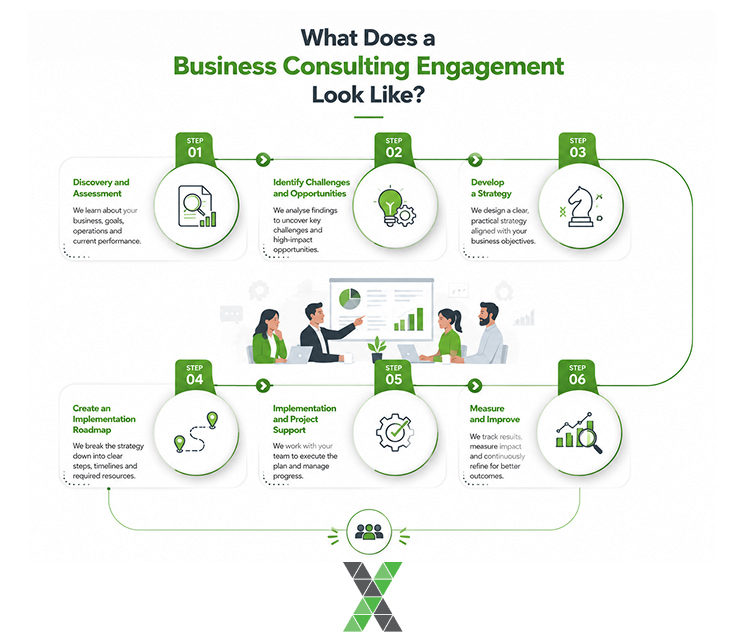 Although every project is different, a typical consulting engagement can follow several stages.
Step 1: Discovery and Assessment
The consultant begins by understanding the organisation.
This can include reviewing:
- Business objectives
- Current systems
- Existing processes
- Technology environment
- Operational challenges
- Workforce requirements
- Customer needs
- Future plans
The goal is to establish a clear picture of the current environment.
Step 2: Identify Challenges and Opportunities
The next stage involves identifying gaps, inefficiencies and opportunities.
For example, a business may have disconnected platforms, outdated devices, inefficient processes or insufficient visibility across operations.
Step 3: Develop a Strategy
The consultant develops recommendations based on the organisation’s priorities.
The strategy should explain:
- What should change
- Why it should change
- Which technologies or processes are required
- What resources are needed
- What the expected outcomes are
- How success will be measured
Step 4: Create an Implementation Roadmap
A strategy becomes more useful when it can be converted into actionable steps.
An implementation roadmap can define:
- Priorities
- Project phases
- Responsibilities
- Timelines
- Dependencies
- Budget considerations
- Key performance indicators
Step 5: Implementation and Project Support
Depending on the engagement, the consulting partner may also assist with implementation. This can include project management, technology deployment, system integration, device preparation and managed services.
Step 6: Measure and Improve
Consulting should not necessarily end when a project is deployed. Organisations should monitor performance and review whether the solution is achieving the intended business outcomes.
Australian Government digital strategy guidance recommends measuring progress, reviewing results and adjusting strategies as business needs and technologies change.
Business Consulting for SMEs, Enterprise and Government
Different organisations require different consulting approaches.
Small and Medium Businesses
SMEs may need support with:
- Business planning
- Digital tools
- Cloud platforms
- Cybersecurity
- Automation
- Websites and online services
- Technology selection
- Process improvement
The Australian Government’s Digital Solutions programme, for example, provides eligible small businesses with access to digital advice covering areas such as business software, AI, cybersecurity, data privacy and digitalisation.
Enterprise Organisations
Enterprise organisations often require more complex consulting.
Projects may involve:
- Large technology environments
- Multiple business units
- Thousands of users or devices
- Complex connectivity
- Fleet deployments
- IoT platforms
- Enterprise architecture
- Digital transformation
- Integration between multiple systems
Enterprise consulting therefore needs to consider both strategic objectives and technical implementation.
Government and Public Sector
Government organisations often manage geographically distributed assets, large workforces and critical services.
Consulting may support:
- Network infrastructure
- Connected assets
- Fleet technology
- IoT deployments
- Digital transformation
- Project management
- Managed services
- Remote connectivity
The consulting approach should be tailored to operational requirements, governance processes and the needs of the communities being served.
EXCEED ICT Business Consulting Services
EXCEED ICT takes a technology-led approach to business consulting, helping Business, Enterprise and Government customers connect strategic objectives with practical ICT solutions.
Its consulting capability focuses on enterprise-scale digital transformation, executive strategic guidance, actionable business initiatives and client-centric partnerships.
EXCEED ICT can combine consulting with project management, managed services, IoT, mobility, connectivity and technology solutions. This creates an approach that can extend from initial strategy through to implementation and ongoing management.
Its consulting services include areas such as technology advice, fleet deployments, application development, enterprise architecture and strategy. EXCEED ICT also has project experience across network rollouts, major device deployments, digital transformation and IoT deployments.
This integrated model can be valuable for organisations that do not simply need recommendations but require support turning strategy into practical business initiatives.
Why Choose EXCEED ICT as a Consulting Partner?
- Strategy and Technology in One Approach: EXCEED ICT combines consulting with practical technology capabilities, helping organisations connect strategic planning with implementation.
- Enterprise Experience: The organisation works with Business, Enterprise and Government customers and supports complex technology environments.
- Digital Transformation Expertise: EXCEED ICT’s consulting offering is positioned around enterprise-scale digital transformation and turning strategic concepts into actionable initiatives.
- Project Management Support: Consulting can be supported by project management capabilities covering strategic oversight, cross-team coordination, risk management and cost control.
- Integrated ICT Solutions: EXCEED ICT’s broader capabilities include connectivity, mobility, IoT, fleet management, managed services and technology platforms, allowing consulting recommendations to be connected with implementation capabilities.
How to Choose Business Consulting Services in Australia
Before selecting a consulting partner, consider the following factors.
- Industry and Technical Experience: Look for a consultant with experience relevant to your industry, operational environment and technology requirements.
- Clear Consulting Methodology: Ask how the consultant will assess your organisation, develop recommendations and measure outcomes.
- Implementation Capability: A strategy is more valuable when the consulting partner can also help implement the recommended solution.
- Transparent Communication: Consultants should explain recommendations clearly and provide visibility into priorities, risks, timelines and expected outcomes.
- Scalability: Consider whether the consulting partner can continue supporting your organisation as requirements evolve.
- Measurable Outcomes: Consulting should ultimately contribute to measurable improvements such as:
- Reduced operational costs
- Improved productivity
- Faster processes
- Better visibility
- Improved asset utilisation
- Reduced technology complexity
- Stronger customer experiences
- Greater operational resilience
The Future of Business Consulting in Australia
Business consulting is increasingly connected to technology, data and digital transformation. Artificial intelligence, automation, IoT, cloud platforms, connected devices, advanced analytics and mobile technologies are changing how organisations operate. As these technologies become more integrated into business operations, organisations will increasingly need consultants who can understand both business strategy and technology implementation.
The most effective approach is likely to be one where consulting is not treated as a standalone report but as an ongoing process of assessment, strategy, implementation, measurement and improvement.
Conclusion
Business consulting services Australia can help organisations make better decisions, improve operational efficiency and plan technology investments around clear business objectives.
From strategy and digital transformation to technology consulting, IoT, mobility, connectivity and project management, modern consulting can address many of the challenges faced by Australian businesses, enterprises and government organisations.
The key is to choose a consulting partner that understands your business objectives and can translate strategy into practical, measurable outcomes.
For organisations looking for a combination of strategic guidance and technology implementation, EXCEED ICT provides consulting, project management, connectivity, mobility, IoT and managed services designed to support business transformation from strategy through to execution.
Ready to Transform Your Business?
Whether you are planning a digital transformation programme, improving connectivity, deploying IoT, managing a large device fleet or reviewing your existing technology environment, the right consulting approach can help turn business objectives into actionable initiatives.
Talk to EXCEED ICT about your business consulting requirements and develop a practical technology and transformation strategy for your organisation.
Call us on 1300 832 639 or simply search “Exceed ICT” on Google Maps to find a location near you and connect with our team today.
We also provide Managed Services, Asset Management, IoT Helpdesk, Fleet Management, Project Management, Telecoms Expense Management.
Improve Your Business Core values, Business Consulting, Network Management, Telstra Adaptive Mobility, Device Enrolment, and many more Solutions.
Find us (Exceed ICT) on Google map.
Comments
Post a Comment